Why governance coverage needs structure, not slogans
Governance content works best when it explains how institutions function, where authority comes from, and how accountability is supposed to work in practice. That means moving beyond personalities and headlines to the real machinery of public life, including parliaments, cabinets, ministries, courts, local government, election bodies and oversight agencies. A good governance episode or essay should help listeners understand who can do what, who checks them, and what happens when those checks are weak.
For a team producing commentary across South Africa, Kenya, Nigeria, Ghana and Zambia, the challenge is consistency. One week the focus may be budget oversight, the next procurement rules, coalition politics, service delivery or constitutional amendments. The subject changes, but the method stays the same: define the issue plainly, explain the institution involved, and show why it matters to ordinary people. That discipline keeps the work non-partisan and useful.
- Start with the public question, not the talking point.
- Explain the institution before judging its performance.
- Use plain language for legal and administrative terms.
Planning the content flow from briefing to publication
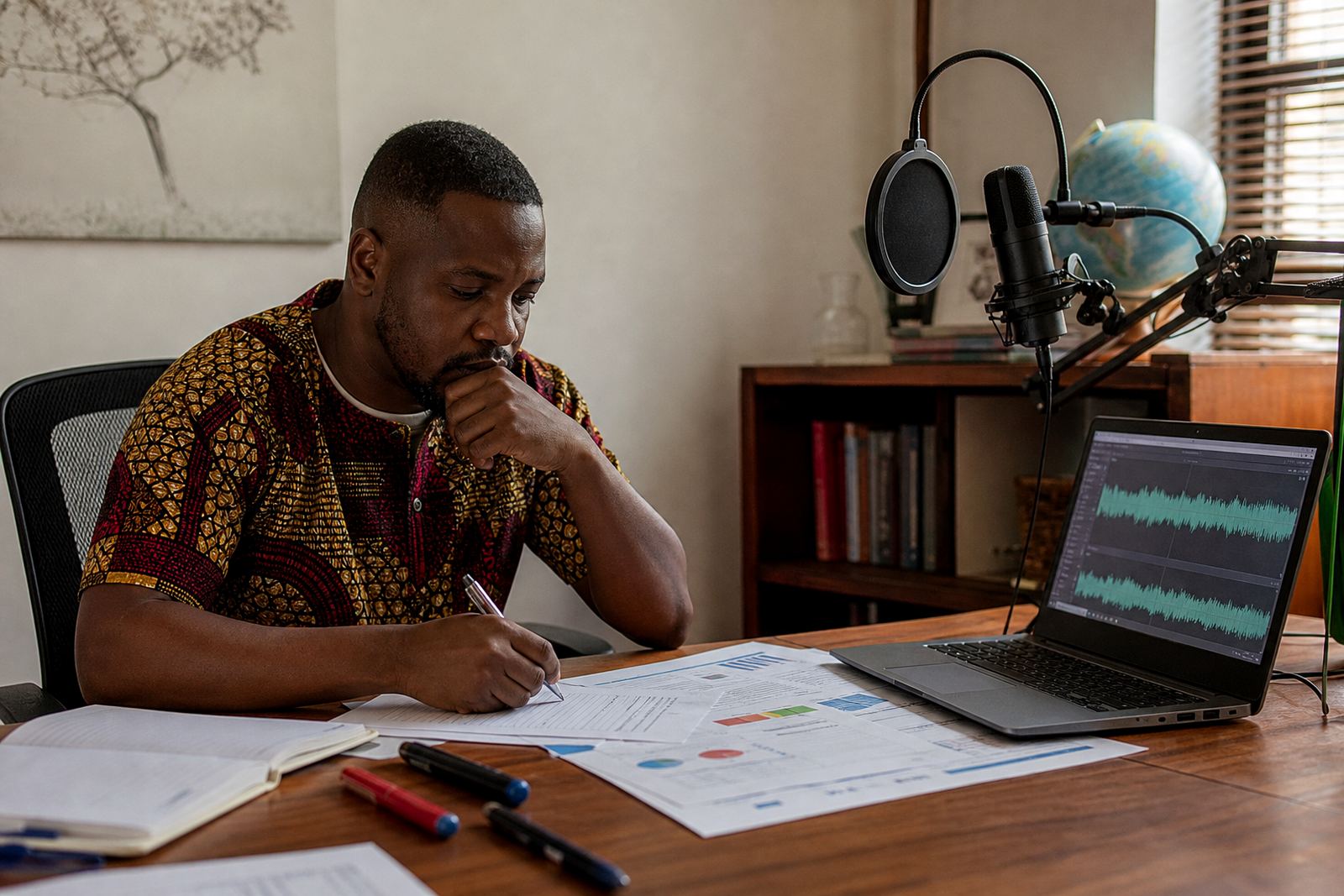
Good planning keeps governance content from becoming vague or overextended. A typical workflow starts with a short editorial brief: what happened, which institution is involved, what the public needs to understand, and what background is required. From there, the research lead and editor can decide whether the topic suits a standalone episode, a short series, or a paired essay and audio release. This saves time and keeps the argument focused.
For this kind of work, a practical layout is to separate the process into research, scripting, recording, edit, and publication. Each stage should have a clear owner. Thabo Michael Mabuza can lead the overall editorial direction, while the editor, producer, research lead and publishing coordinator handle their parts in sequence. That division helps avoid duplication and last-minute changes that can muddy the final piece.
A sensible planning rule is to keep one core question per episode. For example, instead of trying to cover state-owned entities, local government and anti-corruption agencies in one sitting, focus on one institution and one pressure point. The result is cleaner, and easier for the audience to follow.
Common mistakes that weaken governance commentary
Many governance pieces fail because they assume listeners already know the system. That leads to jargon, rushed context and conclusions that sound stronger than the evidence. Another common mistake is treating a legal or institutional issue as if it were only a political fight. The legal framework often matters just as much as the personalities, and sometimes more. A fair analysis should explain both the rule and the reaction to it.
Another trap is overloading one episode with too many countries or examples. Comparative work is useful, but it needs discipline. If South Africa, Kenya and Nigeria are all mentioned in the same script, the comparison should be deliberate and clearly signposted. Otherwise the listener can lose the thread. It also helps to avoid guessing motives or filling gaps with speculation when the public record is thin.
- Do not skip background on the relevant constitution, statute or policy process.
- Do not overstate certainty when facts are still emerging.
- Do not mix commentary, reporting and opinion without clear labels.
Budget ranges for a governance podcast and publication programme
Budget depends on how often you publish, how much research is needed, and whether you want audio only or a combined audio and essay package. For a lean monthly governance output with scripting, editing and publication scheduling, a small operation in Gauteng might budget from about R12,000 to R25,000 per month. That would suit a modest cadence with a narrow topic list and light audio treatment.
A more developed programme, with deeper research support, fact checking, audio mastering, archive management and regular essay editing, can sit in the range of R30,000 to R65,000 per month. If you want a multi-country series, tighter turnaround times, and stronger show notes for each release, the budget can move higher. It is often better to spend on research and editing first, then add extra polish later. A good script is cheaper than fixing a confused episode after release.
Clients working from Rosebank or elsewhere in Johannesburg often also need a contingency for power backup, internet resilience, and occasional remote coordination with contributors in Pretoria, Soweto, Nairobi, Lagos, Accra or Lusaka. Those practical costs should be included early, not added at the end.
How Populism Africa Review handles institutional topics
Populism Africa Review is set up for careful political explanation rather than party line commentary. The team combines editing, research, production and publishing support so that governance topics can be handled from first brief to final archive. That makes it easier to keep tone consistent, source notes tidy, and releases on schedule. It also helps when a topic needs both an episode and a written essay, since the core research can carry across both formats.
Public power is organised through institutions, and clarity matters. Easy answers usually miss how institutions work, where accountability tends to hold, and where it tends to fail. Context and reasoned explanation matter more than noise.
For a commentary brief, write to Populism Africa through the contact page form with your topic, format and deadline, which keeps the first step simple and orderly. From there, the team can scope the work, agree the format, and plan publication around the issue at hand.