Opinion usually starts with lived experience, not a speech
People do not begin with a full political theory. They begin with rent, transport, clinic queues, power cuts, water interruptions, job searches and the feeling of whether public institutions answer when called. Those experiences are the first layer of political judgement, because they are immediate and hard to ignore.
In South Africa, a resident in Soweto may judge government differently after a month of irregular refuse collection, while someone in Rosebank may focus on policing, municipal services or the cost of living. In Nairobi, Lagos, Accra or Lusaka the names of the offices change, but the pattern is similar. Public opinion often forms when people compare what leaders promised with what they can see in their street or ward.
This is why political explanation should start with the ordinary. If a writer or producer skips lived experience, the analysis can sound clever but feel far from reality.
Discussion spaces shape what feels normal
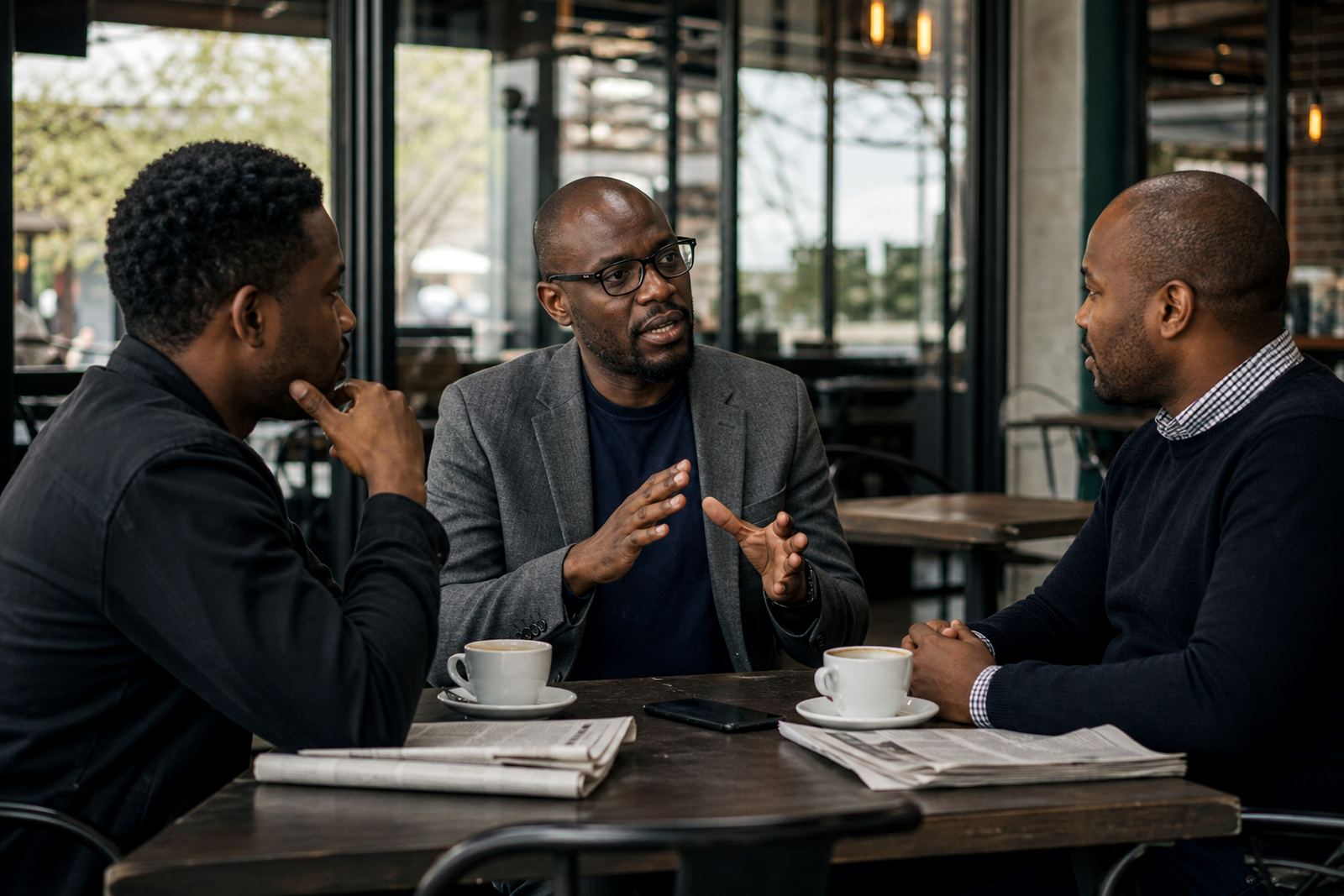
Opinion hardens through repeated conversation. At home, on taxis, in shebeens, at church, in a university residence or in the queue at a municipal office, people test ideas against one another. A view that is repeated by trusted people begins to feel familiar, even before it is fully checked.
That does not mean every group thinks the same way. It means people look for social signals. They ask whether a claim sounds sensible, whether it has been discussed before and whether the speaker understands local conditions. In political judgement, familiarity can count almost as much as evidence, which is why careful discussion matters.
- Ask what problem people are actually describing, not only what position they are taking.
- Notice which setting is shaping the view: family, workplace, religious space, campus or online group.
- Separate a strong feeling from a proven fact. They are not always the same thing.
When public debate is healthy, disagreement can clarify issues. When it is poor, the loudest voice can crowd out better reasoning. That is true in Johannesburg as much as it is in Accra or Lusaka.
Media does more than report, it frames the story
News media, podcasts, essays and social platforms do not only pass on information. They decide what comes first, what is repeated and what gets left out. That framing affects public opinion. A corruption story framed as a question of ethics will be received differently from the same story framed as an administrative failure or a legal matter.
For audiences, the useful habit is to ask: what is the central claim, what evidence is being used and what is the missing context? A clear explanation of a budget issue, a parliamentary procedure or a court process can reduce confusion. Poor explanation does the opposite and leaves room for rumour.
In a city like Johannesburg, where people follow local, provincial and national politics at once, this matters even more. A policy issue can be misunderstood if the media discussion mixes up responsibility between a municipality, a province and a national department.
- Check whether a story explains the institution involved, not only the event.
- Look for dates, documents and procedures where available.
- Be cautious when a headline is more certain than the body of the reporting.
Institutions teach people how to judge politics
Public opinion is shaped by how institutions behave over time. Elections matter, but so do courts, legislatures, ombuds offices, public broadcasters, local councils and regulatory bodies. When institutions act predictably, people are more likely to trust the process even when they dislike a result. When institutions appear inconsistent, people often turn to suspicion and speculation.
That is why political education should not focus only on personalities. People need to know what a committee does, how a bill becomes law, what a municipal bylaw means and where a complaint should go. Understanding the machinery of government helps citizens judge performance more carefully.
For example, if a community in Pretoria is worried about water supply, the public discussion should not stop at blame. It should also ask which office is responsible, what budget line is involved and whether the issue is maintenance, procurement or enforcement. That kind of clarity changes the quality of opinion.
Why social media speeds up belief and doubt
Social media can widen access to politics, but it also compresses time. A half-checked claim can travel quickly, and repeated exposure can make it feel true before it is tested. People often react first to the tone of a post and only later to the content. In that environment, outrage spreads fast, but patience does not.
Still, online spaces are not simply a problem. They can also help people compare notes across cities and countries. A young listener in Lagos may learn from a constitutional debate in South Africa, while someone in Lusaka may follow a local governance issue in Nairobi. That cross-border conversation can be useful if it stays grounded in facts.
The challenge is discipline. Before forwarding a claim, ask whether it identifies a real institution, whether the timeline makes sense and whether the conclusion is bigger than the evidence. That simple pause protects public debate.
A Johannesburg example of opinion taking shape
Think of a neighbourhood in Johannesburg where residents are discussing recurring service interruptions. One person hears a complaint on a local community group, another sees a short clip online, and a third hears a relative speaking about the same issue at work. Soon the conversation becomes political. People begin asking whether the municipality is acting quickly enough, whether the ward office is responsive and whether the explanation matches what they experience on the ground.
What makes the opinion form is not one source alone. It is the mixture of direct experience, repeated discussion and the credibility of the sources people trust. A resident who has spent years following city meetings may interpret the same event differently from someone who only sees fragments online. That difference is normal.
For public commentators, the practical lesson is clear: if you want people to think more carefully, explain the issue in a way they can test. Name the institution, trace the process and keep the language plain. Public opinion becomes sharper when citizens can see how the pieces fit together.
- Start with the lived problem.
- Explain the institution and process.
- Show the limits of what is known.
- Distinguish evidence from repetition.