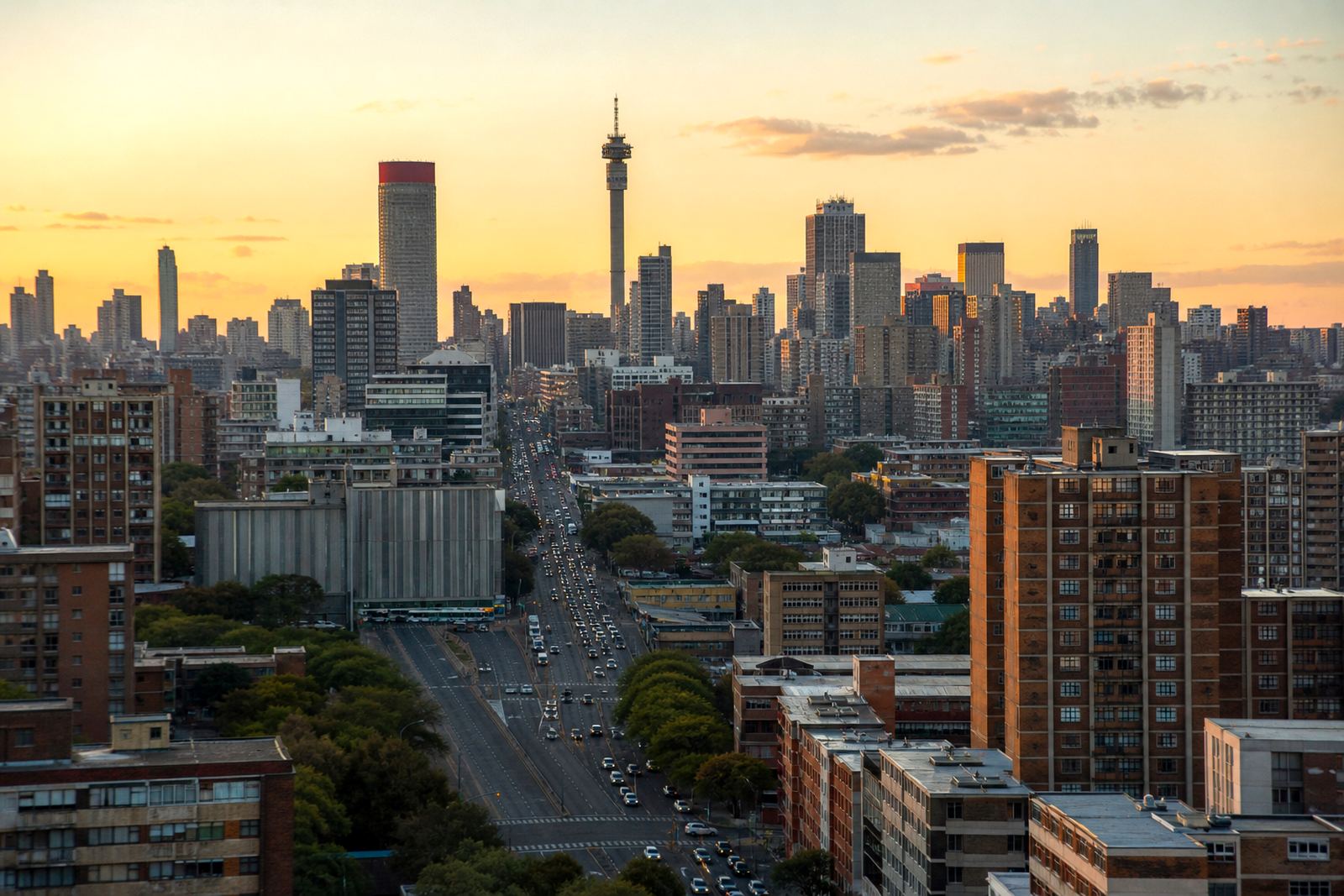
When more people live closer together, politics gets louder
City growth changes the scale of politics. In a smaller town, a problem can stay local for weeks. In a dense city, a broken water pipe, a delayed bus route or a failing clinic becomes a public argument by lunchtime. That is why urban growth often produces sharper demands on government, faster mobilisation by residents, and more pressure on municipal leaders to explain what is happening.
Density also changes what citizens expect. People living in apartments, townhouses, backyard rooms and informal settlements want the same basics, but they experience them differently. One group may worry about parking and refuse removal, another about taps, electricity and safety. City politics has to hold all of those concerns at once, and that is never simple.
In Johannesburg, this is easy to see in places where office districts, transport corridors and residential areas sit close together. A decision about a taxi rank or a bus route does not only affect commuters. It affects traders, security guards, students, landlords and workers who rely on a timetable that must function before sunrise. Urban politics becomes practical very quickly.
Density turns services into political tests
In a spread-out area, poor service delivery is painful. In a dense city, it can become unstable. One burst pipe can affect many homes, one substation outage can interrupt business and study across several streets, and one delayed waste collection can create health concerns fast. Urban residents usually notice these failures in real time, so politicians are judged less by speeches and more by whether the bins were collected, roads repaired and streetlights fixed.
That is why city governments need visible systems, not only policies on paper. Residents want to know who is responsible for potholes, drainage, by-law enforcement and public lighting. They also want predictable timelines. When that information is missing, rumours spread and trust drops. It is not unusual for frustration to build around issues that are technically small but affect daily life, and that is where urban politics gets tense.
- Clear reporting channels help residents track faults without repeating the same complaint to three offices.
- Scheduled maintenance works better in busy areas than waiting for emergencies to pile up.
- Public notices in plain language reduce confusion about roadworks, load restrictions and water interruptions.
- Ward-level meetings can be useful if officials actually follow through on the commitments made.
Urban citizens organise differently from rural voters
City residents often live and work in different places, which changes how they organise politically. A person may sleep in Soweto, work in Sandton and study in Braamfontein. That kind of movement creates overlapping interests and more contact with public systems. It also means people compare services across neighbourhoods, and they notice when one area seems to receive faster attention than another.
Urban communities tend to use multiple channels at once. They may attend a ward meeting, speak to a residents association, join a labour forum and follow local issues on social media. This makes city politics more immediate but also more fragmented. Leaders can no longer assume that one meeting, one poster or one speech will reach everybody. They must communicate across languages, income levels and neighbourhood identities.
There is another difference too. In cities, young people often enter politics through housing, transport, unemployment and public safety before they join a party structure. That means city politics can be issue-led rather than loyalty-led. For commentators and publishers, this is important because it helps explain why urban public debate can shift quickly from one matter to another.
Johannesburg shows how infrastructure shapes political trust
Johannesburg is a useful example because it combines high density with old infrastructure, constant movement and large inequalities. Roads, water systems, electricity networks and public buildings have to serve people across suburbs, inner-city buildings, townships and informal settlements. The pressure is continuous. When systems hold, political trust can recover. When they fail, residents begin to question whether anyone is in control.
In a city like this, politics is not only about who is elected. It is about whether streetlights work on time, whether repairs happen before the next storm and whether public transport remains affordable enough for workers and students. The city is also a place where civic groups, journalists, researchers and residents can document patterns of failure, which strengthens accountability if the facts are handled carefully.
For a political commentary platform, Johannesburg offers a clear lesson: urban growth creates more voices, but also more responsibility. The city is too large for slogans and too busy for vague promises. People need explanations that connect institutions to outcomes, and they need those explanations in language that makes sense locally.
- Track what the municipality controls and what sits with provincial or national departments.
- Separate political blame from administrative failure where possible, because the two are not always the same.
- Pay attention to budgets, procurement and maintenance schedules, not only public statements.
- Use neighbourhood examples to show how one decision affects transport, housing and safety together.
The politics of cities is really the politics of proximity
Urban growth forces strangers to share space. That sounds simple, but it changes the nature of public life. Zoning decisions, land use debates, taxi routes, rental pressure and informal trading rules all become political because they shape who gets to live where, move how and earn what. The city is where class, race, language and age meet in tight spaces, and that makes compromise both necessary and difficult.
This is why city politics should not be treated as a side issue. It is often where the future of a country becomes visible first. If a city cannot manage housing pressure, waste removal, road safety and service fairness, national debates eventually inherit the same problems. The reverse is also true: when city institutions work well, they create habits of accountability that people begin to expect elsewhere too.
Practical commentary on African politics should therefore keep one eye on the street and one on the system. The street shows what is breaking down. The system shows why it is breaking down and who is meant to fix it.
What to watch when cities grow fast
Fast urban growth is not only a demographic fact, it is a political warning. When housing, transport and utilities grow slower than population, frustration builds. When councils fail to communicate clearly, residents fill the gap with guesswork. When public space is crowded but poorly managed, conflict becomes more likely. Good political analysis needs to notice those patterns before they harden into crisis.
The question is not whether cities matter. They already do. The better question is how urban pressure changes power, institutions and public expectations in each country. Johannesburg, Nairobi, Lagos, Accra and Lusaka each have different histories, but all show the same broad truth: where people cluster, politics becomes more visible, more urgent and harder to hide.
Careful city-focused commentary shows politics not as a series of distant statements, but as a daily negotiation over roads, services, rules and trust. In a growing city, that is where democracy is tested first.